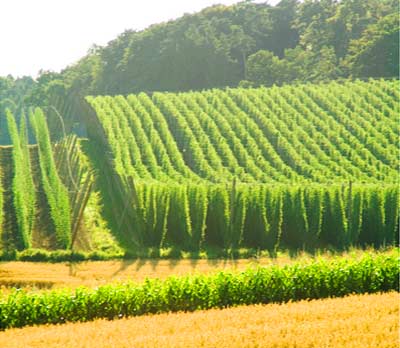
 One disclaimer I will give is that they will not do as well in pots as they do in well-dug, deep soil. The root structures are extensive, and need somewhere to go. If your planting Cascade hops (which I recommend) don't worry about frost much after the first year, they are quite resilient.
Three years ago I planted hop rhizomes for Cascade, Nugget, Willamette, and Chinook hops. Each plant had variable results for me.
First a little background: I have a degree in turfgrass management. In case you have no idea what that means; it means I took plant science classes and the gist of these classes had to do with keeping plants alive. I also grow lots of vegetables and fruits in my home garden. Prior to planting, I read up on growing hops on the internet. I even consulted the section on growing your own hops in The Complete Joy of Homebrewing, by the father of American homebrewing: Charlie Papazian. So needless to say, shovel in one hand, pint in the other, I was prepared.
One of the most important things about growing hops is that the first year, you will not be harvesting a whole lot of them. Not to worry, hops are perennial (they come back every year) and need to establish an extensive root system to take in nutrients and produce the flower cones that we boil in our beer. If you choose to grow them, be patient. Don't expect to be brewing with exclusively your own hops the first year.
My first year went as follows:
The Cascade hops, a North American hop variety, they grew like weeds. The vine was almost uncanny to watch, as it easily grew about a foot a day. I barely had to water them after they were well established. I watered them about once a week in a summer with slightly above average temperatures, and little rainfall. By the end of the season I had roughly 5 ounces of fresh, good-looking Cascade hops. The second year, the vine grew so vigorously, that my pole couldn't hold them. It broke in a wind storm; which cost me a lot of potential hops. The majority did survive though.
The Nugget vine also did well. Not quite as well, but I harvested a couple ounces. The Nugget vine also kept to that foot per day guideline. The second year was much the same, but more bountiful.
The Willamette vine grew, but not nearly as quickly as the other two. It was slow out of the gate and only produced about 12 total hops the first year. The second year was far better, I harvested about three ounces off of it. I actually have a surplus, being as I don't use a lot of them in recipes. (Speaking of: if anyone has a particularly tasty beer recipe with lots of Willamette, I would love the recipe, I'm getting itchy to brew again.)
The Chinook hops were a failure. Not suprising; they do better in hotter and drier climates than the Mid-Atlantic region. They grew, but the vine looked very weak and spindly by comparison. A lone hop shaking limply from the top of the vine. Pathetic. They are also very sensitive to frost. I ended up digging the plant out after the first year, replacing it with another Cascade.
All-in-all, the experience was decidedly awesome. When I used the hops, my batches tasted as good as those using store bought whole hops. However, harvesting hops is not very fun after the first time you do it. It may just be me, but the sticky-ness of the vines and leaves made me really itchy. Wear long sleeves. Also, if you are scared of heights, vines can grow about 20 feet into the air. The cones are not all ready at the same time, ruling out the possibility of chopping the whole vine down to harvest. You will have to be comfortable standing on the "Do Not Stand Above Here" step of the ladder and picking hops. The Cascade and Nugget vines became so productive, I actually couldn't use all of the hops I harvested before they became freezer burnt. Additionally, with the cost of one-ounce bags of hops topping out at around three dollars, you aren't going to be saving lots of money, unless you plant a lot and have a lot of free time.
For these reasons; and a need for more garden space, I dug up my vines last fall. Granted, after I move and have a larger yard, I will plant more. Still, there is no doubt that professional hop growers can probably provide you with a more consistent and high quality hop supply than you can grow on your own. The choice is up to you. If you want to plant them, it can be fun and you will have a giddy sense of pride when you try your first beer that contains your little hop babies. Brew it up.


